Author: ErisAdderly

  • Halloween Story Teaser

    My entry for the Literotica Halloween Contest is just over 6000 words, and I have to say, I’m jumping up and down in my seat wanting to blab the title. And later this week, I will!

    But first, an excerpt. Who is this guy? Any guesses? And no spoilers, those privileged couple of you who actually know! 

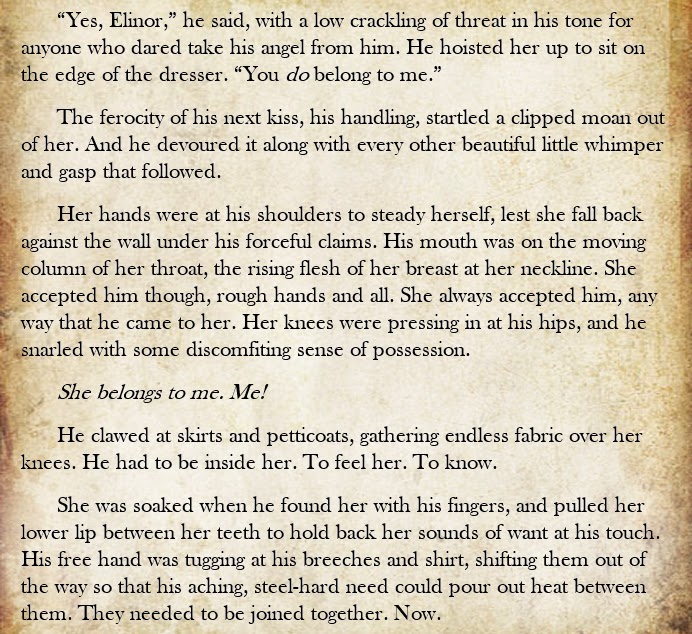
    excerpt screenshot from Halloween Story


    This was from part of the story I wrote on Saturday, and I was really hoping to get more written today than a mere 1100 words or so, but I had to spend my time prepping by researching silly things like:

    • Correct forms of address for late seventeenth century (again).
    • Common evergreens used for garden hedges in the UK.
    • My trusty list of common seventeenth century British first names, and surnames.
    • How people were chosen for teaching positions at Oxford and Cambridge in the late seventeenth century.
    Hedges? Universities? Hawt secks? How does it all go together? Tell me what you think! Are you curious? 
     
    I can’t wait for the reveal!
  • 10 Useless Facts About The Devil’s Luck, Chapter 2

    Hey there, pirates! I got a pretty decent response on my Facebook page about my previous post, 6 Useless Facts About The Devil’s Luck, Chapter 1, so I’m moving on to more chapters and more useless (but fun, I hope!) trivia.

    I have ten tidbits for you from Chapter 2, but I suspect it will vary, since I’m just picking out notable details as I go. Hope you find it as nerdily fascinating as I did!

    1. I realis(z)ed British spellings would probably be best.

     

    Fact: I live in the US. Have all my life. My parents, too. And their parents, on and on back to the Mayflower. What can I say, we don’t move around much. My point is, I’m used to American spellings of words. When I was mid-way through writing this story, however, I got it in my head that since the year was 1716, and all of my characters are British, perhaps I should use the spellings of my Motherland. Let’s face it, no one in 1716 was clamoring for anything, without their trusty ‘u’ along to guide them.

    So off I went to Wikipedia to thoroughly pore through an article detailing spelling differences on either side of the Atlantic. Veeery interesting. Harbor/harbour gets used a lot in The Devil’s Luck, and I never realized how much I say realise when I write. And then there are other fun words like plow/plough, maneuver/manouever. Also, skeptical spelled sceptical still looks weird to me. Those and so, so many others. I also learned that Americans weirdly bunch together words like forever and anyway (elsewhere they’re for ever and any way).

    I painstakingly searched my document (only 108K words, mind you) for any word that might need changing and made the modifications. It was only after the story was done that I realized (yes, there’s my pesky American ‘z’ again) I could switch the proofing language to UK English in Word and not have to kill myself looking for all of what needed to be changed. Sigh. Live and learn, eh?

    2. Benjamin was there to shake things up.

    When the first inklings of this story came into my head, I only knew I wanted to write a pirate story. Because I am obsessed with the both the actual history and the glorified silly pop-culture of all things Age of Sail and Golden Age of Piracy. I have my theories as to why, but those are for a far stranger blog than this. I knew, however, from perusing a few pirate romances on my own (mostly to feel out what material was already out there in an attempt to not inadvertently duplicate someone else’s plot), that the standard trope is for the captain to take the heroine prisoner and then they end up falling in love, or at least lust.

    I thought, what about more than just the captain? There’s a ton of men on the ship, and I like hearing about some group sex, why not a threesome? And then my poor brain started boiling away, looking for a way to make that happen so that the captain wasn’t just pimping her out to his friends, but that all parties could be genuinely interested in one another, and (the real challenge) the two men don’t get jealous of each other.

    Thus, Benjamin Till was born. I wanted him to sort of be the one to convince her that Blackburn wasn’t necessarily the jerk he seemed at first, and our dear Hannah would end up falling for both of them, as they both enchant her in different ways. Here’s a snippet of the first time you see Benjamin easing into this role, in his attempts to calm her down a bit in that take place in Chapter 2:

    [content_box type=”without-header” text_color=”dark” color=”color-alt-1″]

    “Be still, Mrs Collingwood,” he counseled, his tone soft and unsettling against her ear, “You’ll only make it worse for yourself.” What struck her was the note of genuine concern in his quiet words, so incongruous with the scene of coercion playing out below the decks of The Devil’s Luck.

    Something about his voice stilled her. Hannah did not know what would come next, but strangely, she believed the large man at her back. It took all of her effort, but she schooled her body into a tight semblance of calm and steeled herself for Captain Blackburn and his dagger.
    [/content_box]

    3. Tow the lines!

    rope on a ship

    “Fetch me some line, Mr Till,” he gave his firm instructions to the towering man behind her. “We’re going to teach Mrs Collingwood what it means to be still.”

    Yes, I learned during my nautical research that all rope aboard a ship is referred to as “line.” And now you know.

    4. How do I get from the captain’s stateroom to the galley?

     galleon illustration
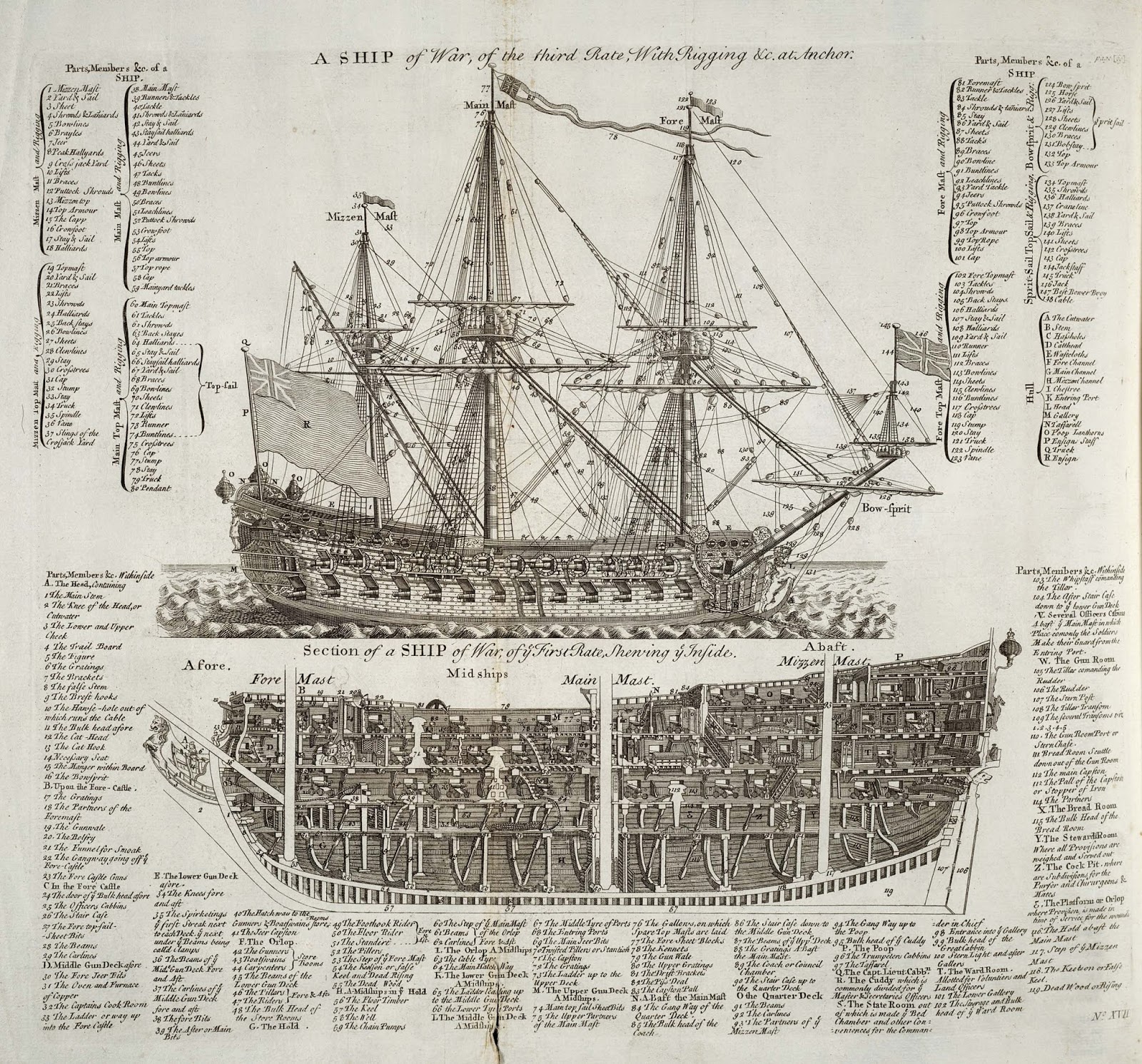
    For the bulk of the story, the characters are all aboard The Devil’s Luck, a “galleon of middling size,” as I described it in Chapter 1. What I needed was a constant reminder of the layout of such a ship (generally), so I could give readers a clear sense of where everyone was going as they moved from cabin to cabin, from the helm down to the lower gun deck, from the forecastle all the way down to the hold.

    This image on the right is the one I used, consistently throughout the story to keep my head straight. The two diagrams were of third rate (exterior view) and first rate (interior) ships of war, drawn in 1728, which was as close as I could find to the year of my story, at least with such detail. You can view the huge, detailed, full size image here. See if you can pick out where Edmund’s stateroom was!

    5. Where’s this ship headed, anyway?

    “Mr Osbourne! Gather those charts of yours and meet me inthe council room. We’d best take a look at our heading.”

     
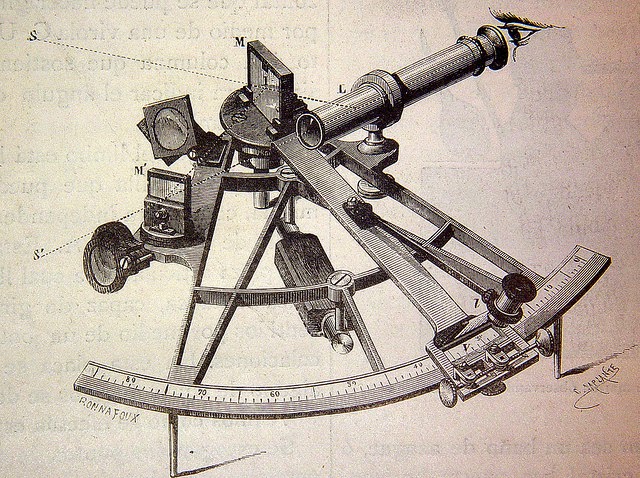
    More learning for me. We always see in the movies the pirate captain poring over charts and busting out his trusty sextant, and while that did happen in real life, what was preferred, I learned, was for the ship to acquire its own designation Navigator, a person with specialized knowledge.
    I found this referenced in a number of places, but one site, SheppeyPirates.co.uk, put it rather well:

    “Pirates often stole not just ships and cargo but members of a ships’ crew and the master or a skilled navigator of a prize – along with his charts and instruments – would be a primary target for any pirates!”

    In fact, the site pointed out just how much skill a person would need, and even then there was a lot of stabbing in the dark:

    “A navigator needs to be literate – to be able to read and write to some degree in order to keep records of where the ship is at any one time. He may or may not have a chart – in 1700 charts were slowly becoming more widely available – but the information on any of these charts was not necessarily accurate and wide areas of the globe still remained uncharted. Currents, the tide and the wind also affect a ship in motion – in simple terms, the ship would also be moving ‘sideways’ to some degree and if you didn’t allow for ‘leeway’ in your calculations you will never plot a true position.”

    If you’re interested in even more of the amazing complexities of navigation at that time, visit the page yourself and dig in. Amazing! Good thing we had Mr Osbourne aboard, or they might never have gotten to Nassau!

    6. We’re only pretending the captain’s in charge.

    Again, the movies just show what’s good for plot and not reality. I learned that on pirate ships of this age that not only was the rank of Captain an elected post, but that the crew could vote him out if they got sick of his nonsense!
    Some captains were voted out and removed for not being aggressive enough for their crews, while others were abandoned by their crews for being too bloodthirsty and brutal. Pirate Captain’s were expected to be bold and decisive in battle as well as e skilled in navigation and seamanship. Above all they had to have the force of personality necessary to hold together such an unruly bunch of seamen.

    Unruly bunch of seamen.

    Ahem. Moving on.

    The position of Quartermaster, too, was apparently an elected post.

    The general rule was that during times of battle the Captain retained unlimited authority, but at all other times he and the rest of the crew were subject to the command of the Quartermaster.

    So you can see that I stretched historical accuracy on this front a bit in the telling of The Devil’s Luck, because there are many instances where Edmund clearly has the ultimate authority, even when they’re not in the middle of a battle. Do I get to claim artistic license on this one? You be the judge. Just don’t make me walk to plank, ok? And if you want to read more about these and other positions on a pirate ship, check out the page I visited here.

    7. Writers love words. Sometimes too much.

    There are times when my vocabulary and love of seldom-used words gets the better of me. And then my editors have to make me see reason. Here’s a standout example of a line you heard in Chapter 2:

    As a boy, Edmund had spent a great deal of his free time exploring the streets of Kingston, messing about as young boys are wont to do. 

    Originally, I’d written this as “footling about”, and not only did Word’s spell check not like it, but neither did my editor. They were pretty sure no one was going to know “footling”. Would you have known it?

    Oxford Dictionary’s website defines the verb to footle as:

    [content_box type=”without-header” text_color=”dark” color=”color-alt-1″]

    footle 
    Syllabification: foo·tle
    Pronunciation: /ˈfo͞otl / 
    verb [no object] chiefly British
    Engage in fruitless activity; mess about:  

    ‘where’s that pesky creature that was footling about outside?’
    [/content_box]


    I don’t know. Sometimes I latch on to weird ones. What do you think?

    8. A little fact, a little fiction.

    Sure the plot of the story is a figment of my imagination, but the surrounding history I wanted to leave as real as possible. And to do that, I like to lace in historical events. Here’s one I wove into this chapter:

    When he’d met Benjamin, the town had not been quite as busy as it was now. He’d only been eight years old, and the earthquake that destroyed Port Royal in 1692, bringing the bulk of the trade business onto the island proper and into Kingston itself, was still four years off.

    True story: there actually was a huge earthquake in 1692 that did just that, bringing the center of commerce in Jamaica from Port Royal to Kingston. Part of my rationale for including dates like this is to enable the reader to figure out how old characters are, if they want to do the math. So Edmund was eight when the 1692 was still four years away, that makes him 12 in 1692, and 36 at the time of our story in 1716. So he was born in 1680. Whew!

    The clues for the rest are in there, Benjamin being two years older than Edmund makes him 38 in the story and born in 1678. And Hannah I cheat and flat-out tell you she’s 28 in Chapter 1, but that was mostly because I wanted the Literotica gods to be sure I was writing about characters who were of legal age. Never can be too careful!

    And speaking of 1692, I’m currently writing a new story that takes place in that year. Can you guess what it’s about?

    9. Water, water, everywhere…oh wait.

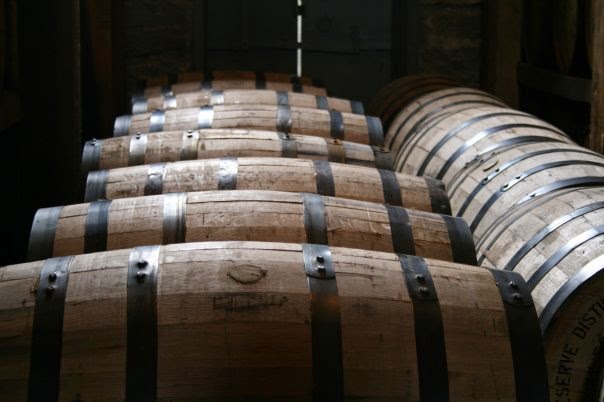
    I think those of us in the developed nations have really come to takewooden barrels readily available, fresh water for granted. I found out, once again learning about life aboard a ship, that this was simply not the case. For some reason I can’t find the link to the original site where I learned this, but fresh water was stored in barrels aboard a ship, and it had a tendency to start growing algae and going bad, so it would be used up at the beginning of a longer voyage. Thus there was so much drinking of alcohol. Plus…pirates.

    Edmund notes this when he’s approaching Hannah shortly after having her taking down from the mast:

    He’d left her with a pitcher and mug of some of the ship’s precious fresh water, of which they still had a fair amount, having only just left port that morning. 

    10. The Mourning Dove

    A reader, who clearly saw better into my own subconscious than I did, asked me if the ship Hannah was originally supposed to board, The Mourning Dove, was symbolic of Hannah herself, as a widow. Riiiiiiight. I meant to do that.

    Hannah is a widow, though, but Edmund doesn’t realize it until she tells him. Why?

    The loss of her husband had to have been some time ago, because she hadn’t worn the black of widow’s weeds, or even the grey of half mourning. 

    At that time, it was customary for a woman to wear mourning black for at least a year after the death of her husband, and some of the bereaved took it as far as four years. Talk about lack of wardrobe variety. And then, as if that weren’t enough, they would often dress in grey for another year, and this was referred to as “half mourning.” The black ensemble was typically referred to on the whole as “widow’s weeds.” And as I noted, Hannah is out of such colors by the time of our story.

    OK! So there’s another collection of stuff and nonsense! Hope to see you again for the facts about Chapter 3!
  • 6 Useless Facts About The Devil’s Luck, Chapter 1

    Because I’m so sure that people are endlessly fascinated in the minutia of my process, I thought it might be fun to do a little “Writer’s Commentary” series of posts on some of the behind-the-scenes nonsense that went into creating The Devil’s Luck. Some of it involves interesting (ok, to me maybe) information I learned in the course of my historical research, resources I used to make the story feel more accurate, plot judgement calls, and even logistical problems. 
     

    Here we go!

    1. All the character’s first names are legit for the time period.

    ahoy: me name be Captain Obvious
    When I went to choose names for the characters in The Devil’s Luck, I wanted them to sound like names people in 18th century Great Britain actually would have had. I wasn’t able find a list for the 18th century, but I was able to find one for the 17th, with the top 50 most common names per decade for the first three decades of that century. Name trends then didn’t change nearly so quickly as they do now, so I felt safe using this list of names for my pool of choices. Hannah is the 19th most popular female name on the list for 1620 – 1629. Edmund is 16th in popularity on the male list, and Benjamin, 30th. Every first name in the story came from this list, except for Brigit (who’s Irish, and this list was tabulated from English names) and Hezekiah (a former slave).
     

    2. There wasn’t always a Brigit.

    That’s right. Originally I had our dear Hannah travelling alone, but my excellent beta-reader pointed out to me that at this point in history, women of any sort of reputation went absolutely nowhere alone, and I was convinced to supply our heroine with at least a maid, hired by her father for propriety’s sake. And thank goodness, too, or we never would have had the pleasure of writing the fun scene where Brigit and the cook, Mr. Bone, have a saucy interaction and tease Hannah a bit down in the galley. And there wouldn’t be Brigit & Bone’s spin-off tale, which I’m in the middle of writing right now!
     

    3. Chapter One of TDL was originally rejected by Literotica

    Literotica has rules about story subrejected stampmissions, and one of those rules is that all descriptions of sexual activity must be between characters who are over 18 years of age. The problem is, the human beings who approve the submissions over there don’t have time to fully read each one, so certain words and phrases flag a rejection. The first time we meet the notorious Rowland Graves, he bribes a couple of boys at the port to do some spying and miscellaneous grunt work for him. It seems some of the wording in that scene set off the red flags:

     
    “You there! Boy!” he hissed at a passing lad, probably no older than eight or nine years. The boy turned a sceptical eye toward him.
    “How’d you like to earn a bit of coin?”
    and this one:

    Once he’d learnt enough, he asked the boy a final question before relinquishing the promised coin. “Have you any friends or brothers, any boys a bit older than yourself? Say twelve or thirteen?”

    Obviously these boys were’t part of any of the story’s adult scenes, and now I’ve learned to include a note with my Lit submissions that all characters involved in adult stuff are of legal age.
     

    4. Ship-shape and Bristol Fashion

     
    When I decided I wanted to start out the story with Hannah in Bristol (after the prologue in Jamaica), I had my work cut out for me researching what it was like for ships to navigate in and out of the port in the early 18th century. What I learned was that the Avon (the river that leads inland to Bristol Port) has a water level that varies a great deal with the tides. It varies so much that, prior to the early 19th century, when locks were built to create a “floating harbor” that would allow a consistent water level to be maintained for the ships, when the tide went out, any ships still stuck in the harbor would be grounded in the mud of the river bed until the tide came back in. Due to this tidal problem and, “because of their keels, [the ships] would fall to one side. If everything was not stowed away tidily, or tied down, the results were chaotic and cargo could be spoiled.” Thus any ships coming through this port were best off keeping tight control over their cargo, and leaving us with the glorious expression that they ought to be “ship-shape and Bristol fashion.”
     
    You can see Graves make reference to it here:

    Crowding the women through the cabin’s entrance, Graves left them no time to quibble about the room. “We aim to make it out on this tide,” he told the pair, “before we’re run aground on the bed of the bloody Avon.

    5. Mrs Collingwood or Hannah?

     
    I had so much to learn when I set out to write this story, and one of those things that cost me a silly amount of research was forms of address for the time period. Turns out that “First names were almost never used in speech, except in extremely limited circumstances, before this century.” My first draft of chapter one didn’t include this, but after some questions raised by my beta-reader caused me to do some additional research, I discovered a number of things. First, most people, especially respectable people, called each other by their title and last name: Mrs Collingwood, Mr Till, etc. Even people as familiar as spouses did this, at least in front of other people. Or they would simply refer to each other by their relation. For example, a wife might say, “Do you wish to retire early this evening, Husband?” It seems odd now, but this was perfectly normal for the time. And so in the story, I show it as a big deal when Blackburn refers to Hannah by her first name, or the first time she calls him Edmund and not Captain Blackburn.
     
    Another thing I discovered was at this point in time, all adult women were referred to as “Mrs”, regardless of their marital status. “Miss” as it’s used today, for single women and girls, was only used at this time for…ahem…women of ill-repute. 
     

    6. Women were going commando.

    Panties? Ain
    Yup. In the 18th century, women weren’t even up to bloomers yet, much less underwear. Beneath the many layers of a woman’s outfit, including bodice, stays, skirts, apron, and petticoats, was the shift. The shift by itself would look like a long night shirt, and was the basic foundational garment at the time. Nothing was worn under the shift. And since it was such an ordeal for a woman to get in and out of her complicated clothing at the time, you’ll find most sex scenes in TDL involving skirts simply being lifted, rather than any complete stripping, which would have truly removed any element of spontaneity from the scenes. If you read historical romances or erotica set in really any time period before the 1920s, and hear about dresses being ripped off in one fell swoop, or in any way easily pulled off over a person’s head, you are definitely not hearing how things really worked at that time


    That’s it for now! Didn’t want to make this post too long – you know how the internet is: TL;DR. Heheh. Let me know in the comments if you’re interested in hearing any more of these little tidbits beyond what I gleaned after a quick review of chapter one. See you next time!
     
  • Lucky Number Seven?

    Oooh, fun stuff, and right when I should be going to bed! I just saw an entertaining idea on my friend Sophie Kisker’s blog, An Oddysey into Erotica:

    She wrote:

    “…in your manuscript,
    1. find page 77
    2. find line 7
    3. post the next 7 sentences

    (or, if your manuscript is not that long, do page 7, line 7).

     
    So I thought it would be fun to try it with The Devil’s Luck. Interestingly enough, my seven sentences happen to fall in two different scenes: the end of one from the male lead’s POV, and then beginning of the next one where I head-hop to the female lead.
     

    Here we go:


    [content_box type=”without-header” text_color=”dark” color=”color-alt-1″]

    She’d been humming along just fine before he chose to lap up her shame in front of Osbourne. He sighed to himself as he was forced to confront once again the one area, that of carnal desire, where he had nearly no control of his impulses. Edmund Blackburn would need to try at least one more time if he wanted to see the Widow Collingwood open herself to the desires he knew she harbored in secret, and he would need to go carefully about it.

    * * * *
     
    Hannah barely had time to recover any semblance of composure before yet another member of Captain Blackburn’s cursed crew came banging through the doors of the stateroom. He carried a bucket and a bit of cloth, and closed the door deftly behind him with one hand. He was not followed by the captain and she steeled herself at the idea of being left alone with still another strange man.

    “Mrs. Collingwood?” he asked. 
    [/content_box]

     
    Well that was entertaining! Thanks Sophie! I’m really going to bed now, I swear!
  • TDL Chapter 8 Teaser

    [icon_box icon=”icon-pencil” icon_position=”left” title=”Update” align=”left”]
    The Devil’s Luck is now available on Amazon in paperback, ebook, and on Kindle Unlimited.
    [/icon_box]
    Matters are boiling quickly toward a climax in The Devil’s Luck. Chapter 7 is back from beta-reading and I’m primed to make some edits, some rearranging of scenes. Chapter 8, the final installment, is underway. Things are getting emotional, even for pirate captains. Here’s a sample:

    [content_box type=”without-header” text_color=”dark” color=”color-alt-1″]
    “Mrs. Collingwood,” he prompted. She made no reply, but stepped briskly where he directed, doing her own part to hasten the affair to a close. The widow appeared as intent as he was on having the painful event done with.

    Mrs. Collingwood.

    He recalled the first time he’d spoken her name, those weeks ago in his stateroom, acting a proper scoundrel, by anyone’s measure. He and Benjamin having a bit of sport with what they thought at the time would be simply another pretty face to exchange knowing elbows in the ribs about later.

    Hannah.

    The name he preferred to call her, a sound ephemeral and free, a wind that filled sails, unseen. That one he’d used that first day, as well, but as a weapon. A tool to make her unsteady, to breach her standards of propriety and set the dogs of fear loose in her mind before offering her a choice of being tied to a mast or tossed over the side.

    A perfectly normal way to begin any courtship, Blackburn, wouldn’t you say?
    [/content_box]

    84,607 words as of this moment. I can taste the end! And soon, you’ll be able to taste the beginning!

     
    Tell me what you think! Are the excerpts all emotion, not enough teasing about the sex? I’ve kind of avoided those scenes, because I don’t want to give away who’s doing what to whom – spoilers and all that! 
     
    – Eris
  • Devil’s Luck Spin-Offs

    [icon_box icon=”icon-pencil” icon_position=”left” title=”Update” align=”left”]
    The Devil’s Luck is now available on Amazon in paperback, ebook, and on Kindle Unlimited.
    [/icon_box]

    The Devil’s Luck is getting somewhere close to completion (I swear, guys), but even though it’s not published yet, I wanted to gush over the fact that yesterday I decided to write two short spin-offs about some of the secondary characters aboard the ship. These are two of the other couples we get just the barest taste of in the main story, and I thought it might be fun to flesh out their naughty activities within their own little vignettes. These will basically be very short stroke pieces (ahem), so if you end up liking The Devil’s Luck, and want to hear more about these characters once you’ve been teased with their stories, then perhaps I’ll see you back around again when these come out.

    Here are the premises:

    The Carpenter and the Deck Hand: A Devil’s Luck Vignette

    Genres: Erotica (Gay Male), Historical

    One of two short spin-offs from The Devil’s Luck, centered around two of the ancillary characters: 

    Ellis George, carpenter aboard The Devil’s Luck, is fairly certain he knows what Christopher Winters wants better than the young deck hand does himself. With some shore leave in store for them at Bristol Port, Ellis decides to show the sailor who’s been helping him with his tasks what he’s been missing, and perhaps teach him some new ways to “work under a master carpenter.”

    The Maid and the Cook: A Devil’s Luck Vignette

    Genres: Erotica, Historical

    One of two short spin-offs from The Devil’s Luck, centered around two of the ancillary characters. 

    Brigit O’Creagh’s day had gone from bad to potentially worse, after first being hired on as a maid bound for the Colonies in service of the prim Mrs. Collingwood, and then finding herself aboard a pirate ship instead when events go horribly awry. Stuck on the ship for who knows how long, and remanded over into the service of the cook, Brigit, the scarred girl from Cork, waits to see what other misfortunes the world can heap on her. What she hadn’t expected, though, is the way John Bone begins looking at her, or the sort of mischief she’s tempted into down in the ship’s galley.

    [icon_box icon=”icon-pencil” icon_position=”left” title=”Update” align=”left”]
    The Maid and the Cook is now available on Amazon in paperback, ebook, and on Kindle Unlimited.
    [/icon_box]

    I’m going to have so much fun writing these! Now focus on finishing the main story, Genius! (That’s me, yelling at myself.)